
When a denture shifts while you eat or speak, the problem does not end with an imperfect fit. Research on complete denture wearers has examined discomfort while eating, interrupted meals, difficulty speaking, concerns about appearance, and changes in social interaction. Taken together, these experiences show how something as basic as denture stability can reach into several parts of your day. Snap-on dentures address that instability by changing how the denture is held in place.
At Atkins Dental Clinic, Dr. Aaron Bratton uses mini dental implants to give snap-on dentures secure points of attachment. Their smaller diameter often requires less bone than conventional implants and supports a less invasive placement process. The denture remains removable, but while you are wearing it, its stability no longer depends on suction and fit alone. It has something secure to hold onto. Because ultimately, the measure of a secure denture is not how firmly it attaches. It is how little it interferes with everything else you are doing.
What Are Snap-On Dentures?
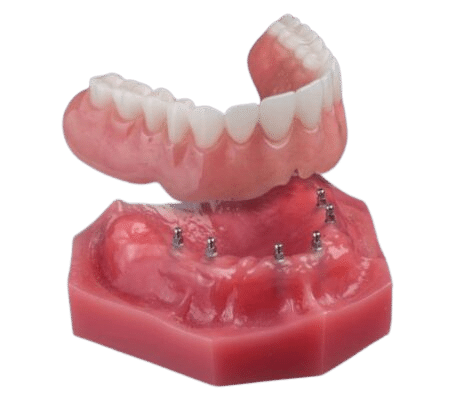

Snap-on dentures, much like traditional dentures, are removable and replace a full arch of teeth. But one key difference changes everything: how they stay in place.
Traditional dentures rely on suction and adhesives, while snap-on dentures lock securely onto dental implants. But why does this difference matter?
The Problem With Traditional Dentures
When you first receive dentures, they are made to fit the shape of your gums and the bone underneath them. The problem is that this shape does not stay exactly the same. After teeth are removed, the jawbone gradually loses volume through a process called bone resorption. A denture that fit well when it was made may eventually be sitting on a very different foundation.
Natural tooth roots normally transfer the pressure of chewing into the surrounding bone. Without those roots, the jaw no longer receives that same stimulation. As the bone changes, the denture can begin to loosen. You may find yourself reaching for adhesive more often, avoiding certain foods, or noticing movement when you speak.
Mini dental implants give Dr. Aaron another way to support the denture. He places the implants in the jawbone, where they integrate with the surrounding bone through a process called osseointegration. Your snap-on denture then connects directly to those implants. The important difference is where the denture gets its stability. A traditional denture depends heavily on the surface beneath it. A snap-on denture has support anchored within the jaw.
Mini Dental Implants: The Foundation for Your Snap-On Dentures
At Atkins Dental Clinic, we use mini dental implants to make implant treatment less invasive and more efficient. Their smaller diameter requires less space in the jaw than conventional implants, which can make treatment possible even when bone is limited.
With conventional implants, insufficient bone may mean adding a bone graft before implant placement. That adds another procedure and additional healing time to the process. Mini implants require less bone, so grafting is often unnecessary. Their smaller size also makes placement less invasive, with less healing time afterward.
Dr. Aaron uses CBCT imaging to measure the height, width, and depth of the available bone and plan the position of each implant. Once the denture and implant placement have been planned, the mini implants can typically be placed and used to stabilize the denture during the same visit. Instead of spending months preparing the jaw for larger implants, some patients can proceed with treatment with the bone they already have.
Book a Free Consultation and Secure Your Smile Today
Living with loose dentures often means making small adjustments throughout the day, from choosing what you eat to being careful when you speak or laugh. Snap-on dentures are designed to take some of that uncertainty out of wearing a denture. By connecting your denture to mini dental implants, we can give it the stability that traditional suction and adhesives may no longer provide.
If your dentures have become harder to manage, Dr. Bratton can evaluate their fit, your available bone, and whether mini implants could provide the support you are missing. Call Atkins Dental Clinic today to schedule your free implant consultation and find out what it would take to keep your denture firmly in place.
