
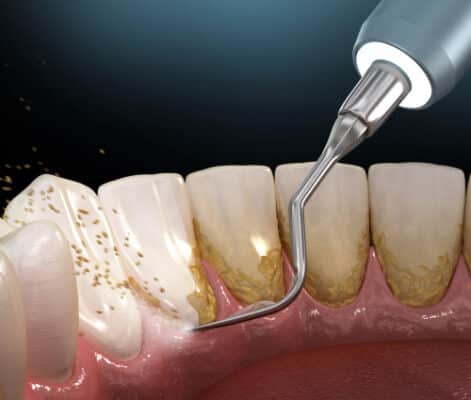
Deep cleaning teeth sounds like something you’ve probably had done at the dentist before. A little extra scraping, a little more polishing, and your teeth are nice and clean. But if your dentist has recommended a deep cleaning, there’s usually a reason that goes further than removing the buildup you can see. A deep cleaning, or scaling and root planing, treats gum disease. If plaque sits on your teeth long enough, it hardens into tartar that can build up along and below your gumline, where your toothbrush can’t reach it. As bacteria build up, your gums can become inflamed and begin pulling away from your teeth. Gum disease can eventually damage the bone supporting your teeth and complicate future dental implant treatment. We use scaling and root planing to remove the buildup beneath your gums, reduce inflammation, and help the tissue heal.
At Atkins Dental Clinic, we want you to understand what’s going on with your gums and why a deep cleaning may be necessary. We’ll cover what the cleaning involves, what you can expect afterward, and how we know if it’s working. If gum disease has already cost you a few teeth, we can pull up your X-rays and see what we have to work with. You might still have some options for dental implants.
Deep Cleaning Teeth To Treat Gum Disease
We start by checking the space between your teeth and gums. Your hygienist uses a small measuring tool to see how deep the pockets are around each tooth. Healthy gums generally have shallow pockets. Deeper measurements can tell us where gum disease has caused the tissue to pull away from your teeth and where we need to focus our attention.
We may numb the area with a local anesthetic before starting the cleaning. We want you to be comfortable, and if something hurts while we’re working, tell us. There’s no reason to sit there and put up with it.
The first part of the cleaning is called scaling. We use dental instruments to remove plaque and hardened tartar from your teeth, including the surfaces below your gums. You may feel some pressure as we work, but the anesthetic helps reduce discomfort.
Next, we smooth the roots of your teeth. We call that root planing. Removing the remaining deposits and rough areas gives your gums a cleaner surface to heal against.
Some patients only need treatment around a few teeth. Others have gum disease affecting much of their mouth. We may finish the cleaning in one appointment or divide the work into several visits. We’ll explain what needs to be done and how much time to plan for.
Deep Cleaning Teeth Before Dental Implant Treatment
Yes, it’s possible. If you have active gum disease, we treat it first. Placing dental implants before the disease is controlled increases the risk of complications, including infection and bone loss around the implants. After treatment, we need to see how your gums respond. We’ll check for bleeding and inflammation and measure the pockets around your teeth. We’re looking for evidence that the disease has stabilized before proceeding with implant placement.
Implant placement depends on the bone available to support the replacement teeth. Dr. Aaron will review your X-rays and show you what he sees before recommending treatment. Some people have enough bone in one area of their jaw but very little in another. Losing bone around one tooth doesn’t automatically tell us what the rest of your jaw can support.
We also consider different implant designs. Traditional dental implants generally require more jawbone space because they’re wider. Mini dental implants have a smaller diameter and can sometimes be placed in areas where a larger implant wouldn’t fit. Dr. Aaron works with both types, which gives us options when the available bone is limited.
A smaller implant isn’t automatically the answer to periodontal bone loss, though. We still need enough healthy bone in the right location to support the implant and the replacement tooth or teeth.
If your bone loss is extensive, additional treatment may be necessary before implants are possible. Some patients may need bone grafting, while others may have suitable areas for a different implant approach. We’ll base that discussion on what your examination and imaging show.
Concerned About Your Gums? Let’s Talk.
Losing teeth to gum disease is frustrating enough without being told you have no options for replacing them. Dr. Aaron doesn’t make that decision based on your dental history alone. He wants to see what’s happening in your mouth today and what your jawbone can support.
If you’ve been dealing with gum disease and are interested in dental implants, contact Atkins Dental Clinic in Atkins, AR, to schedule an appointment. We’d be glad to see you.
