

Do clear aligners work compared to braces? It’s a question that tends to come up for a reason. A clear, flexible tray does not appear to match the strength of metal brackets and wires, so it raises a fair question about how it actually performs. At Atkins Dental Clinic, we have treated many orthodontic cases with clear aligners and have seen how reliably they move teeth when the case is suited to that approach. Their popularity reflects that consistency. Patients choose them because they can achieve meaningful alignment while remaining far less noticeable throughout treatment.
Still, clear aligners may not work for every scenario. More advanced misalignment or complex bite concerns still call for a different level of control. When a case falls into that category, Dr. Aaron Bratton refers patients to an orthodontic specialist. For many patients, though, clear aligners are more than capable of achieving the outcome they seek. They are an effective, reliable way to reach the same end result.
How Do Clear Aligners Work?
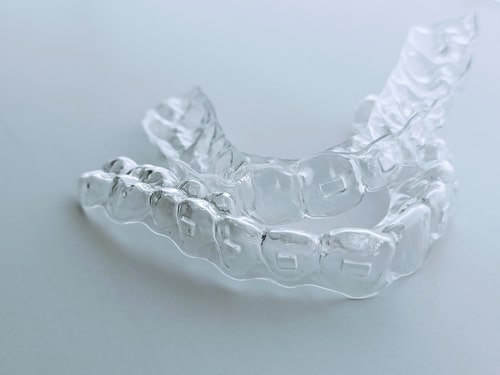
Brackets and wires look strong, so it’s fair to question how a clear material can keep up.
Clear aligners use medical-grade thermoplastic engineered for a specific balance of flexibility and rigidity.
When you place an aligner over your teeth, it doesn’t sit passively. Each tray is shaped slightly ahead of your current tooth position. That small mismatch creates tension as the aligner settles over the teeth. Instead of pulling from a wire, the aligner applies steady pressure across the entire surface of each tooth. You feel that pressure as a snug, controlled hold rather than a single point of force.
That full coverage changes how the force is delivered. Brackets apply pressure through a wire connected at specific points. Aligners wrap around the tooth, contacting the front, back, and sides at once. That contact allows the force to distribute evenly, guiding the tooth through bone remodeling in a more uniform way. Movements like tipping, rotation, and even torque still occur, but they are driven by a series of small, pre-planned adjustments rather than continuous wire tightening.
It can help to picture each aligner as a single step in a sequence, rather than a single tool doing all the work. One tray introduces a slight shift. The next tray builds on it. Over time, those controlled steps move teeth into alignment without the need for visible hardware. The strength isn’t coming from a rigid structure pressing harder. It comes from consistency, coverage, and the way each stage is designed to move your teeth just enough before the next one takes over.
Do Clear Aligners Work Faster Than Braces?
Treatment time with clear aligners and metal braces often falls within a similar range. Some aligner cases move along quickly, especially when adjustments are limited. Across the board, aligners do not consistently move teeth faster than braces. The timeline is set by what needs to change and how the body responds to that change.
Teeth do not slide through bone like objects on a track. Movement happens through bone remodeling. When steady pressure is applied, the body breaks down bone in front of the tooth and rebuilds it behind it. That cycle has a natural pace. Pushing teeth faster than that pace increases the chance of irritation around the roots and reduces long-term stability.
The type of correction sets the length of treatment. Small spacing or mild crowding may resolve in a shorter window. Rotations, bite changes, and larger shifts take longer because each adjustment builds on the one before it. A more involved plan often extends into a longer timeframe.
Clear aligners depend on consistent wear to maintain steady pressure. Removing them for extended periods interrupts that pressure and slows movement. Braces stay in place, so force continues without interruption.
Age and oral health influence how quickly the body completes each step of bone remodeling. Younger patients often respond more quickly. Inflammation or inconsistent hygiene can slow the process and require additional time to keep treatment on track.
Both systems work within the same biological limits. The pace comes from how the body reshapes bone, not from the material used to move the teeth.
Find Out If Clear Aligner Treatment Is Right for You
A clear tray may not look as forceful as brackets and wires, but orthodontic treatment has never relied solely on appearance. Tooth movement depends on steady, controlled pressure and a plan that guides each step. Clear aligners are built around that process.
If you want to know what clear aligners can do for your smile, we can evaluate your teeth, walk you through your options, and map out a plan that aligns with your goals. Schedule a consultation at Atkins Dental Clinic to see how this approach can work for you.
