
Most improvements in dentistry do not come from starting over. They come from taking something that already works and asking how it can work better. A traditional denture does a lot. It restores a full smile and helps you return to a more balanced diet. It replaces what was lost in a way that feels complete again. But there are points where it can fall short in day-to-day use. That is where the next question begins. How can we keep what works and improve what does not? A roundhouse bridge is one answer to that question.
A roundhouse bridge restores a full arch of teeth, much like a denture, but approaches design and support differently. With support from mini dental implants, it stays in place and relies less on the factors that traditional dentures depend on.
What Is a Roundhouse Bridge?
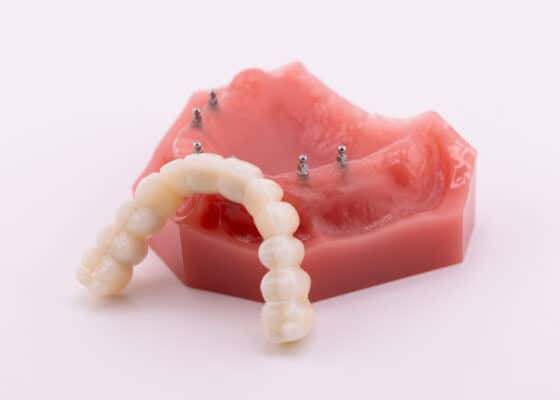
A roundhouse bridge is a full-arch dental prosthetic that replaces an entire row of teeth on the upper or lower jaw. It forms a continuous, U-shaped arch that follows the natural curve of your jaw.
The design stays within that natural arch. It does not extend across the roof of the mouth or spread broadly over the gums. Instead, it follows the same path your natural teeth once occupied, so it stays close to the gumline without adding extra material.
Traditional dentures rely on a thick acrylic base that covers a larger portion of the gums and, on the upper arch, the palate. That coverage helps create suction and stability, but it also adds bulk that can affect how the restoration feels during speech and daily use.
Dr. Aaron anchors a roundhouse bridge to dental implants placed throughout the jawbone. Those implants support the restoration directly, so it does not rely on the broad acrylic base used in a traditional denture. The design is built around that support, rather than around suction or coverage.
Supporting a Roundhouse Bridge With Mini Dental Implants
Dr. Aaron often supports a roundhouse bridge using the Fix-on-Six® system. In this approach, he anchors the bridge with a series of mini dental implants placed throughout the jaw, typically between six and ten, with eight being common.
This system creates what is often called a fixed hybrid bridge. The restoration stays securely in place day to day, so you do not remove it at home. During routine visits, Dr. Aaron removes the bridge in the office to clean around the implants and maintain the health of the surrounding tissue. At home, you care for it as you would natural teeth.
Mini dental implants are key to how he delivers this treatment. Each implant measures less than 3 millimeters in diameter, about half the width of a traditional implant.
Due to their smaller size, Dr. Aaron places a mini implant using a minimally invasive technique. He creates a small pilot opening through the gum and positions the implant directly into the bone without making incisions.
For a Fix-on-Six® case, he places several of these implants across the arch and then secures the bridge to them. This approach has allowed Dr. Aaron to treat a wider range of patients over the past decade, often reducing the need for more extensive surgical procedures while still providing stable support for a full-arch restoration.
Explore a More Stable Way To Replace a Full Arch of Teeth
A roundhouse bridge builds on what a denture already does well and refines how that result is supported. When support comes from a different source, the entire experience can change in ways that are easy to overlook at first and hard to ignore once you notice them.
If you are weighing your options for full-arch tooth replacement and want to understand how a roundhouse bridge with mini dental implants compares, contact us today to book a free implant consultation. At Atkins Dental Clinic, Dr. Aaron can help you determine if a more stable approach is within reach.
